

Fact Sheet FS1237
Origin and Distribution
Japanese stiltgrass (Microstegium vimineum) is an invasive grass that threatens native plants and natural habitats in the eastern United States. Native to Japan, China, central Asia and India. M. vimineum was originally documented in Tennessee in 1919 and is believed to have been accidentally introduced to the United States through its use as a packing material.
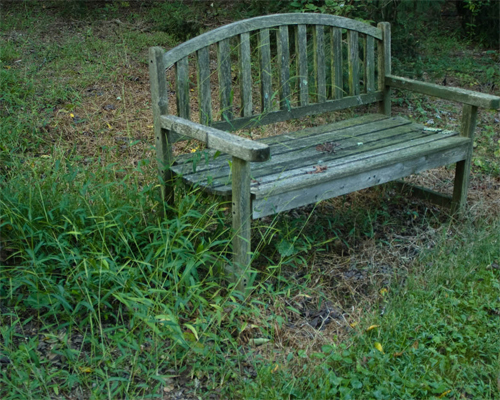
Stiltgrass thrives in moderate-to-densely shaded areas subject to regular soil disturbances, such as flooding, mowing, tilling, and high foot traffic. Stiltgrass is commonly found along roadways and ditches, floodplains, moist woodlands, and power line corridors. Stiltgrass often thrives in soils that are moist, acidic to neutral, and fertile. Stiltgrass also threatens wooded areas where tree canopies are defoliated due to infestations of gypsy moths or other destructive events. In residential areas, stiltgrass can invade lawns, landscape beds, and vegetable gardens. Stiltgrass does not proliferate in full sunlight or in areas with standing water.
Biology and Identification
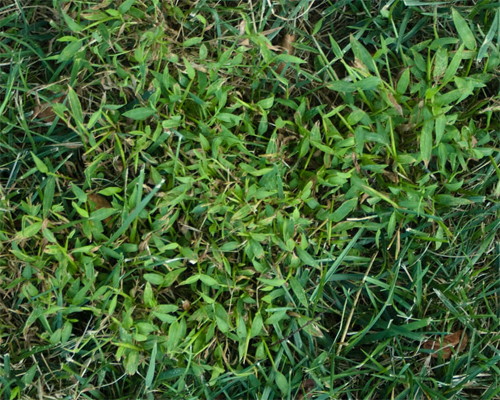
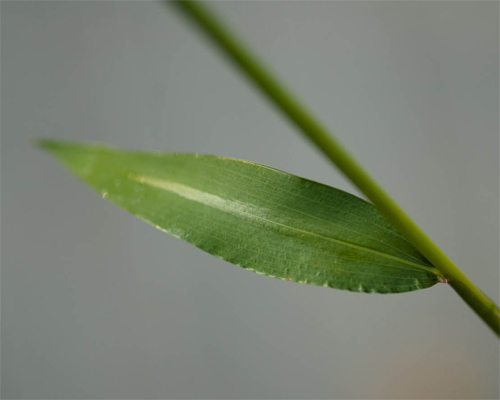
M. vimineum is an annual grass that germinates in the spring, grows to heights of 2 to 3½ feet, and dies back in the fall. Stiltgrass is identifiable by its pale green, lanceshaped leaves that have a silvery stripe of reflective hairs along the midrib of the upper leaf surface. The leaves are alternate and range in length from 1 to 3 inches. Stiltgrass resembles bamboo, but its stems are thin and wiry, and can be green, purple, or brown. In August through early-October, the plants generate slender flower spikes that appear in pairs. After blooming, dry fruits are produced, which are yellow to red in color. In the fall, the plants develop a purplish tinge. At the end of the season, dieback of the plant produces a thick layer of dried, tannish thatch in heavily infested areas.
M. vimineum exhibits several traits common to invasive species, such as rapid growth, abundant seed propagation within one season, and rapid invasion of disturbed habitats. Stiltgrass grows in extensive patches, displacing less competitive native species. The roots of stiltgrass are shallow, but rooting from stem nodes that touch the ground facilitates its spread.
Each plant can produce up to 1,000 seeds from both self-fertilizing and cross-fertilizing flowers. Once in the soil, seeds can remain viable for up to 5 years. The seeds are small and easily adhere to clothing, shoes and animal fur, which aid the spread of M. vimineum along woodland pathways, lawns and gardens. Deer and other grazing animals further enable infestation by feeding on native plants and avoiding the stiltgrass. Additionally, overgrazing of the understory of a forest canopy by animals improves light conditions and removes plant competition for the invasion of M. vimineum. Once established, M. vimineum may impact surrounding plants by increasing shade. Left unchecked, native vegetation in susceptible areas can be overtaken in three to five years.
Several native grasses resemble Japanese stiltgrass, so before applying any control, it is important to correctly identify Microstegium vimineum. Native species that stiltgrass can be confused with include Virginia cutgrass (Leersia virginica Willd.), Pennsylvania knotweed (Polygonum persicaria L.), crabgrass (Digitaria spp.), and nimblewill (Muhlenbergia schreberi J.F. Gmel.). The identifiers for Virginia cutgrass included its longer leaves (up to 6 inches), its flat, compressed seed heads, and the fact that it is a perennial. Knotweed can be identified by its pink calyx and glossy black nutlets. Crabgrass and nimblewill can be differentiated by their stalky stems and branching seed heads.
Control
Early control of new infestations and preventing the drop of viable seed are critical for preventing the establishment and spread of Japanese stiltgrass. Small populations are fairly easy to eradicate with hand pulling. Large populations likely require herbicide treatment. There are no known biological control methods.
In Landscape Beds
Mechanical Control
Hand hoeing and hand pulling can be an effective means to control stiltgrass as long it is done before it has dropped seed (~ mid August in NJ). Recognize that hoeing or pulling stiltgrass early in the season (before August) disturbs soil which can stimulate germination of new plants from the seed bank. Constant mowing such as in a lawn will cause stiltgrass to grow at a lower height but still set seed. A more successful control strategy is to mow plants just before flowering (~early August in NJ) which cuts off the flowering culm before seed matures.
Cultural Control
Various mulches can be used to exclude light from the soil and keep stiltgrass from germinating.
Chemical Control
Preemergence Herbicides
Trifluralin (tradenames include Preen Garden Weed Preventer® and Treflan®) can be used to prevent stiltgrass seeds from germinating in planting beds. Trifuralin must be applied according to the label and it should not be used in areas in which ornamental flowers will be directly seeded into the soil (as opposed to transplanted into the area).
For landscape professionals only:
Pendimethalin (tradenames Pendulum®, Prowl®)
Postemergence Herbicides
Postemergence herbicides are most effective when applied before plants set seed.
Glyphosate and Glufossinate (various trade names) can be used to spot treat Japanese stiltgrass in gardens and planting beds. Both are broad spectrum herbicides that should be applied only to the unwanted plants. If applied to the foliage, stems, or woody portions of desirable plants, it could damage them as well.
Sethoxydim (tradename Bonide Grass Beater Over-the-Top Grass Killer®) and Fluazifop-P-Butyl (Ortho Grass B Gon Garden Grass Killer®) are selective herbicides that can be applied to growing stiltgrass in landscape beds. When used according to the label, these herbicides will not damage most non-grass ornamental plants. Be sure to follow the label closely and heed all precautions.
For landscape professionals only:
Fexoxaprop-p-ethyl (tradename Acclaim Extra®) imazapic (tradenames Plateau®, Cadre®) and sethoxydim (Poast, Vantage)
Fluazifop-P-Butyl (tradename Fusilade®), clethodim (tradename Select®)
Quizalofop (Assure II)
In Lawns
Cultural Control
Growing and maintaining a healthy, dense lawn is the best preventative method to discourage the introduction of and growth of Japanese stiltgrass in turfgrass. Proper seed selection, mowing, liming and fertilizing according to a soil test, watering, etc. are all important cultural practices for maintaining healthy turfgrass (Refer to the njaes.rutgers.edu website or your local County Extension Office for more information on maintaining a healthy lawn). Note that routine mowing of stiltgrass in a lawn area will cause stiltgrass to set seeds at a low height. If the stiltgrass does set seed in mid to late summer, very low mowing and bagging of the clippings may help to collect some of that seed and prevent it from being deposited into the lawn. Keep in mind that very low mowing can also damage desirable turfgrass species, and overseeding may be needed to re-establish lawn cover.
Mechanical Control
Hand pulling can be effective for control of small infestations of Japanese stiltgrass. It is important to remove it before seed is dropped (~ mid August in NJ).
Chemical Control
Preemergence Herbicides
The same herbicides that can be used to prevent crabgrass from germinating and growing in a lawn can be also be used to prevent stiltgrass germination. For more detailed information on these materials homeowners should see Rutgers Cooperative Extension Fact Sheet FS1308 "Crabgrass Control in Lawns for Homeowners in the Northern US," and landscape professionals should refer to Rutgers Cooperative Extension Fact Sheet FS1309 "Crabgrass and Goosegrass Identification and Control in Cool-Season Turfgrass for Professionals."
Postemergence Herbicides
Fenoxaprop (trade name Acclaim Extra and Bayer Crabgrass Killer for Lawns) kills annual grasses after they have emerged from the soil, and is approved for use on established perennial ryegrass, tall fescue, fine fescues, and Kentucky bluegrass. Stunting or discoloration may occur on succulent, rapidly growing and seedling Kentucky bluegrass turf but these symptoms will subside if precautions on the label are followed. Fenoxaprop must be applied at low rates on bentgrass. Do not mix with the broadleaf weed herbicides, 2,4-D or MCPP,(or apply within 21 days following application of 2,4-D or MCPP or 5 days before 2,4-D or MCPP application. Treated turf should not be mowed within 24 hours of application to allow penetration and translocation into the grassy weeds. Fescues and ryegrass can be reseeded at any time following application of fenoxaprop. Reseeding of all other turf grasses should be delayed at least 21 days after application.
References and Resources
Mention or display of a trademark, proprietary product, or firm in text or figures does not constitute an endorsement by Rutgers Cooperative Extension and does not imply approval to the exclusion of other suitable products or firms.
October 2023
Copyright © 2024 Rutgers, The State University of New Jersey. All rights reserved.
For more information: njaes.rutgers.edu.
Cooperating Agencies: Rutgers, The State University of New Jersey, U.S. Department of Agriculture, and Boards of County Commissioners. Rutgers Cooperative Extension, a unit of the Rutgers New Jersey Agricultural Experiment Station, is an equal opportunity program provider and employer.