


Fact Sheet FS593
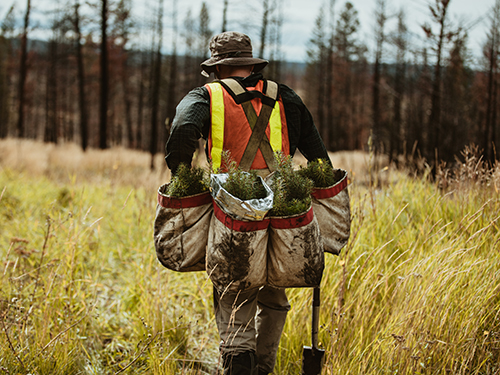
One of the joys for many landowners of owning and managing woodlands is working in the woodlot. For these owners, doing their own timber stand improvement, thinning, planting, wildlife habitat enhancement, and, in some cases, even their own harvesting, are integral parts of woodland ownership.
Just as with any other business or farm operation, safety "on-the-job" in the woodlot is an important consideration. It is important to note that as of 2024, chain saw accidents alone account for some 36,000 injuries that result in emergency department visits annually in the U.S. Working safely in the woods should be a concern for all woodland owners, regardless of the extent or degree to which they do their own management activities. Ideally, working safely in the woodlot should become both necessary and second nature.
The following is a guide or checklist for working safely in the woods. Much of it is common sense, and most of the items are simple and easy to do; but they all result in safer and more pleasant work experiences in the woods.
- Carefully plan all activities.
- Notify someone of your plans: where you plan to be, when, what you are doing, when you plan to return. Periodically notify these individuals of your current status.
- Carry a first aid kit and other emergency medications you may need (inhaler, EpiPen, etc.) with you.
- Wear appropriate clothing for the task at hand:
- Dress warmly in cold temperatures, layering when necessary.
- Wear cool clothing in hot temperatures such as light-colored, loose-fitting clothing (if not using certain machinery- see below), and a hat with a wide brim.
- When appropriate, wear proper or loose-fitting clothing to allow for ease of movement for certain activities such as walking or loading. However, do not wear loose-fitting clothing when working with certain machinery, such as chain saws, to prevent risk of snags with the machinery.
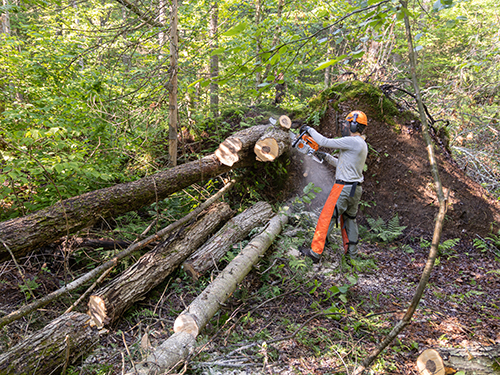
- Use appropriate protective clothing, such as chainsaw chaps and ear and eye protection.
- Wear sunscreen.
- Be knowledgeable about Lyme disease and other tick-borne diseases, and aware of the steps to avoid problems (wear light-colored clothing and a hat, check skin for ticks daily after working in the woods, take a shower or bath as soon as possible after returning from working in the woods), including repellents. If using repellents, read and follow all label instructions. If using both sunscreen and a repellent, apply sunscreen first, and then apply the repellent after.
- For more information on ticks, tick-borne diseases, and repellents, please visit:
- Centers for Disease Control and Prevention:
- US Forest Service:
- Environmental Protection Agency:
- If you know you have allergic reactions to insect stings, carry a sting treatment kit with you; and carry it with you into the woods, don’t leave it behind in your vehicle.
- Be aware of any other venomous insects or animals in your area, be able to recognize them, and know what to do if stung or bitten.
- Avoid dehydration and heat exhaustion; know the symptoms and how to treat them; always take and drink plenty of water. Remember: if you feel faint or weak, stop working and go to a cool place. For more information on symptoms and prevention of heat-related illness, please visit:
- Centers for Disease Control and Prevention:
- Occupational Safety and Health Administration:
- Stay alert, take rest/water breaks frequently.
- Pack nutritious lunches or snacks for long workdays. Combined with numbers 8 and 9 above, proper nutrition and hydration help fight fatigue, which is a factor in many accidents.
- Properly maintain all equipment and tools, keeping sharp tools sharp, since they work better that way. Proper maintenance assures better efficiency, production, and lowers accident potential.
- Acquire and use the proper safety equipment for the task at hand: hardhats, ear protection, eye protection, gloves, boots and steel-toed boots, chaps (protective pants), and other protective clothing when using a chain saw or other equipment.
- Select and use a chain saw that has all the current safety features such as a chain brake, hand guard, chain catcher, safety chain, spark arrestor, and vibration-absorbing handle. Do not operate a chainsaw in the field alone, have a second person with you for emergencies and general safety.
- Avoid heavy work in the woods during inclement weather.
- Do not drink alcoholic beverages when working in the woods.
- Plan ahead: in the event of an accident, know where the closest possible assistance is located.
- Keep your devices charged and have a backup plan in case of weak cellular reception.
Working in the woods can certainly be satisfying and rewarding for woodland owners. Just remember to always work safely in the woods, and that planning and common sense are key. Before undertaking any activity in the woods, it is also advisable to first discuss it with your professional forester.
So, for you landowners who are able and so inclined, "have at it!" And "work safely!"
The original publication was made possible, in part, by a grant from the National Institute for Occupational Safety and Health Program on Agricultural Health Promotion Systems for New Jersey. It was authored by Mark C. Vodak, Extension Specialist in Forestry, Retired.
References
November 2025
Copyright © 2026 Rutgers, The State University of New Jersey. All rights reserved.
For more information: njaes.rutgers.edu.
Cooperating Agencies: Rutgers, The State University of New Jersey, U.S. Department of Agriculture, and Boards of County Commissioners. Rutgers Cooperative Extension, a unit of the Rutgers New Jersey Agricultural Experiment Station, is an equal opportunity program provider and employer.